


Red Dot Sight Specifications Explained: MOA to IP67
Red dot sights often look alike, but a few specifications separate a good optic from a poor one: dot size, parallax, brightness range, adjustment and zero retention, battery life and durability. This guide explains what each figure means and what values to look for, using JOVSTAR sights as examples. For all models, see our red dot sight selection guide.
Magnification and Field of View
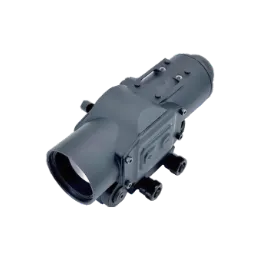
A true red dot sight is 1×: the view through it matches the naked eye, so the user can aim with both eyes open. JOVSTAR’s JV-RDS-01, JV-HRDS series and JV-HS-01 are all 1×. Magnified options add detail at distance at the cost of field of view: the JV-ZS-01 gives 21° at 1× and 3.5° at 6×.
Dot Size in MOA
Dot size is given in minutes of angle (MOA). One MOA is 1/60 of a degree, which covers about 2.9 cm at 100 m. A 1 MOA dot therefore covers about 2.9 cm at 100 m, and a 30 MOA circle about 87 cm.
- Small dots (1–2 MOA) cover less of a distant target and suit precise aiming.
- Large circles are faster to find when the sight comes up quickly at close range.
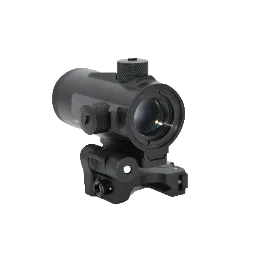
- Dot-circle reticles combine both. The JV-RDS-01 offers six dot-circle patterns with a 1 MOA center dot and a 30 MOA circle.
Parallax
Parallax is how far the dot appears to move against the target when the eye is not centered behind the sight. Good sights keep it small so the point of aim stays put however the head is positioned. JOVSTAR figures: ≤1 MOA on the JV-RDS-01, ≤1.5′ (arc minutes) on the holographic JV-HS-01 and ≤2 MOA on the compact JV-HRDS series.
Brightness and Night Vision Settings
The dot must be bright enough to see against a sunlit background and dim enough not to flare on a dark night. Look for several brightness steps. If the sight will be used behind night vision devices, look for dedicated night vision settings, as on the JV-HS-01, so the reticle does not bloom in the night vision image.
Adjustment Range and Click Value
Windage and elevation adjustments move the dot to match the point of impact. Two figures matter:
- Adjustment range: how far the dot can be moved in total, for example ≥±40 MOA on the JV-ZS-01 and ≥±10 mil on the JV-HS-01.
- Click value: how far one click moves the dot, for example 0.25 MOA on the JV-ZS-01. Smaller clicks allow finer setting.
Some sights adjust in mils instead of MOA. One mil (milliradian) is 1/1000 of the distance: 10 cm at 100 m, or about 3.4 MOA.
Zero Retention and Repeatability
A sight is only useful if it holds its setting. Two specifications describe this:
- Zero position variation after removing and refitting the sight: ≤1 mil on the JV-HS-01 and ≤1.8 MOA on the JV-RDS-01.
- Impact rating, the shock the sight withstands: 1000 g on the JV-RDS-01 and JV-HRDS series, 1200 g on the JV-ZS-01 and 1500 g on the JV-HS-01 and JV-TS-03.
Battery Life and Power
LED red dots are very efficient: the JV-HRDS series and the JV-ZS-01 are rated for ≥10,000 hours on one CR2032 coin cell. Holographic sights use more power: the JV-HS-01 runs ≥8 hours of continuous operation on AA batteries. Check the battery type as well; CR2032 cells are small and light, while AA cells are easy to find worldwide.
Durability and Environment
| Model | Housing | Protection | Operating temperature | Weight |
|---|---|---|---|---|
| JV-RDS-01 | 6061-T6 aluminum | IP67 | -40℃ ~ +50℃ | <150 g |
| JV-HRDS series | — | IP67 | -20℃ ~ +40℃ | ≤50 g |
| JV-HS-01 | 6061-T6 aluminum | IP67 | -40℃ ~ +55℃ | ≤300 g with mount |
| JV-TS-03 (3×) | 6061-T6 aluminum | IP67 | -40℃ ~ +55℃ | ≤300 g with mount |
| JV-ZS-01 (1×/6×) | 6061-T6 aluminum | IP67 | -40℃ ~ +50℃ | ≤465 g |
IP67 means the sight is dust-tight and withstands temporary immersion in water. For cold climates, check the lower temperature limit; for hot regions, the upper one.
A Quick Specification Checklist
- 1× magnification, or the magnification range you need.
- Dot or reticle size suited to your distances.
- Parallax of about 1–2 MOA or less.
- Brightness steps for daylight and night, and night vision settings if needed.
- Adjustment range and click value suited to your use.
- Zero retention and impact rating.
- Battery type and life.
- IP67 protection and an operating temperature range for your climate.
Comparing red dot and holographic technology? See red dot vs holographic sight. JOVSTAR can configure reticles, brightness settings and housings for distributors and equipment makers through our OEM and ODM service.
FAQ
How big is a 1 MOA dot?
One MOA is 1/60 of a degree, about 2.9 cm at 100 m. A 1 MOA dot covers about 2.9 cm at 100 m.
What is a good parallax figure for a red dot sight?
About 1–2 MOA or less. JOVSTAR sights are rated at ≤1 MOA (JV-RDS-01), ≤1.5′ (JV-HS-01) and ≤2 MOA (JV-HRDS series).
What does IP67 mean for a sight?
IP67 means the sight is dust-tight and withstands temporary immersion in water. All JOVSTAR red dot, holographic and magnified sights are IP67.
Need Help Choosing the Right Product?
Tell us your application, target and operating conditions. The JOVSTAR engineering team will recommend a configuration and prepare a quote.
Get a Quote