


Integrating a Laser Rangefinder Module into a UAV Gimbal
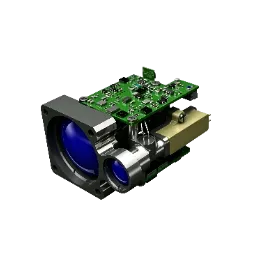
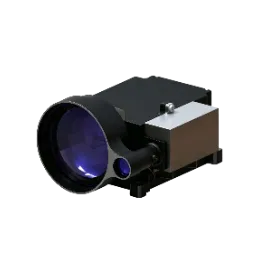
Adding a laser rangefinder to a drone payload or gimbal gives the operator a measured distance to whatever the camera is looking at. That distance is also the missing input for geolocating a target, and for mapping and inspection measurements. This guide walks through the integration decisions in the order engineers usually meet them: range requirement, weight and power, interface, mounting and boresight, data output, and testing. For the full module range, see our laser rangefinder module selection guide.
1. Define the Ranging Requirement
Start from the target, not the module. Write down what the payload must range (ground, structures, vehicles, people or vessels), the furthest and closest distances, and the flight altitude and viewing angle. A drone ranging the ground from 120 m altitude needs a very different module from a gimbal tracking vessels several kilometers away.
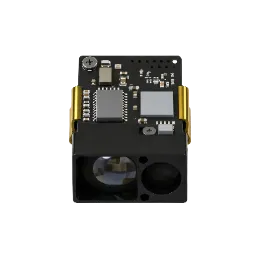
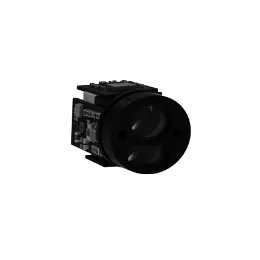
- Short range, very light payloads: 905 nm modules range up to 1.2–2 km on large targets and weigh 5–6 g.
- Mid to long range, small targets: 1535 nm modules range 4–25 km on large targets, and 1.5 km to 13 km on a human-sized target.
- Ground at shallow angles: check that the range is specified on natural terrain. The JV-LRF1505AD is rated at ≥5 km on sand, grass, desert and gobi at grazing angles up to 79°.
2. Weight and Power Budget
On a drone, every gram costs flight time, and the gimbal motors must be able to balance the extra mass. Weigh the module together with its connector, cable and bracket.
| Model | Weight | Supply | Average power | Peak power |
|---|---|---|---|---|
| JV-LRF902BD (905 nm) | ≤5 g | DC 3.3–5 V | ≤0.6 W @3.3 V, 1 Hz | ≤1.35 W |
| JV-LRF901FD (905 nm) | ≤6 g | DC 3.3–5 V | ≤0.6 W | ≤1 W |
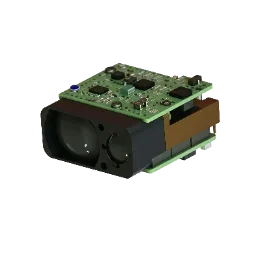
| JV-LRF1503DD (1535 nm) | 14 g ±1 g | DC 3–16 V | ≤1.5 W | ≤3 W |
| JV-LRF1503AD (1535 nm) | ≤34 g | DC 5–16 V | ≤0.8 W @1 Hz, ≤1.5 W @10 Hz | ≤3 W |
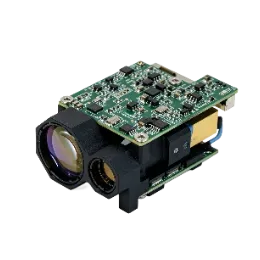
| JV-LRF1508AD (1535 nm) | ≤60 g | DC 4.5–14 V | ≤0.6 W @1 Hz | ≤5 W |
| JV-LRF1505AD (1535 nm) | ≤80 g | DC 10–14 V | ≤2 W | ≤5 W |
Size the power rail for the peak, not the average: the module draws its peak current each time it fires. Several modules have a power-enable input that drops standby consumption. The JV-LRF1503AD draws ≤1 mW with POWER_EN low, so the payload controller can switch the rangefinder off between measurements.
3. UART-TTL or RS422
The interface should match the distance between the module and the board that reads it.
- UART (TTL 3.3 V) suits short connections on the same board or within one compact payload housing. The JV-LRF901FD, JV-LRF902BD/CD, JV-LRF1503DD and JV-LRF1503AD use it.
- RS422 uses differential signaling and tolerates longer cables and electrically noisy platforms. Choose it when the rangefinder sits in a gimbal head with the cable running through slip rings to a controller in the airframe. The JV-LRF1505AD uses RS422, and the JV-LRF1508AD offers RS422 or TTL.
Match the logic level as well. A 3.3 V TTL module connected to a 5 V UART needs a level shifter.
4. Mechanical Mounting and Boresight Alignment
The rangefinder is only useful if its beam hits the point at the center of the camera image. Long-range 1535 nm modules use beams of 0.45–0.8 mrad, so a small mounting error moves the laser spot well away from the target: 1 mrad of misalignment is a 2 m offset at 2 km.
- Mount the module and the camera on one rigid bracket, so they move together under vibration and temperature changes.
- Provide a way to adjust or electronically offset the alignment during assembly.
- Align on a distant target, not a close one: parallax between the camera and laser apertures shrinks with distance.
- Leave the transmit and receive windows clear. Any cover glass in front of them must transmit at the module’s wavelength (905 nm or 1535 nm), and must not reflect the outgoing pulse straight back into the receiver.
- Recheck alignment after vibration testing.
5. Data Output and Update Rate
Most JOVSTAR modules support single-shot ranging plus continuous ranging at 1–10 Hz; the JV-LRF1505AD runs at 1–5 Hz. For a gimbal that tracks moving targets, use continuous mode and read the newest value. For mapping or inspection, single-shot measurements triggered by the payload controller save power.
With multi-target modules, decide which echo the system should use. The JV-LRF1503AD and JV-LRF1505AD report up to three targets. The JV-LRF1505AD also flags front and rear targets, so the software can ignore a branch or wire in front of the real target. To place the target on a map, combine the distance with the gimbal angles and the drone’s GNSS position and heading.
6. Test Before Flight
- Bench test: supply, current at peak, communication and update rate.
- Ground test: range known targets at known distances, including small and dark targets.
- Environmental check: vibration and temperature. JOVSTAR 1535 nm modules typically operate from -40℃ to +60℃ (JV-LRF1505AD to +70℃), and 905 nm modules from -20℃ to +60℃.
- Flight test: confirm alignment and readings in the air before relying on the data.
Recommended JOVSTAR Modules by Payload Class
| Payload class | Module | Why |
|---|---|---|
| Micro and small drones | JV-LRF902BD / JV-LRF901FD | 5–6 g, 3.3–5 V, up to 2 km on buildings |
| Mapping and inspection drones | JV-LRF1503AD | ≤34 g, ≥5,000 m on buildings, three-target detection |
| Gimbals with long cable runs | JV-LRF1505AD | RS422, -40℃ to +70℃, rated on natural terrain |
| Long-range EO gimbals | JV-LRF1508AD | ≤60 g, ≥10,000 m on buildings, RS422 or TTL |
If your payload needs a different interface, mounting or ranging configuration, our OEM and ODM service can adapt a module to your system.
FAQ
What is the lightest JOVSTAR laser rangefinder module?
The 905 nm JV-LRF902BD weighs ≤5 g and measures ≤22.5 × 15.5 × 9.5 mm. The JV-LRF901FD weighs ≤6 g. Among 1535 nm modules, the JV-LRF1503DD weighs 14 g ±1 g.
How is the rangefinder aligned with the camera?
Mount the module and the camera on one rigid bracket, then align the laser to the center of the camera image on a distant target, by mechanical adjustment or an electronic offset. Recheck alignment after vibration testing.
Should I use UART-TTL or RS422 on a drone?
Use UART-TTL when the module sits close to the board that reads it. Use RS422 when the cable is long or runs through gimbal slip rings, because its differential signaling resists noise.
Can JOVSTAR modules be customized for a specific gimbal?
Yes. JOVSTAR supports project-level customization of interfaces, mounting and ranging settings to match the host system.
Need Help Choosing the Right Product?
Tell us your application, target and operating conditions. The JOVSTAR engineering team will recommend a configuration and prepare a quote.
Get a Quote