


How to Choose a Thermal Monocular: Lens, Resolution, NETD
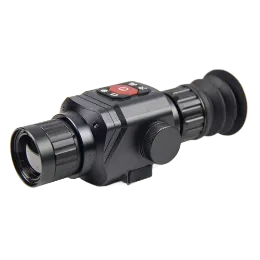
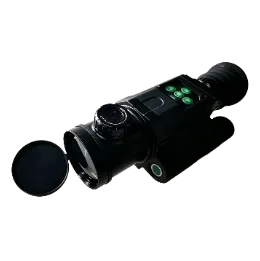
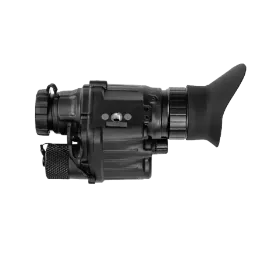
To choose a thermal monocular, start with the distance and the task, then pick the lens, the detector resolution and the sensitivity that match. Weight, battery life, recording and protection come next. This guide walks through each choice with the JOVSTAR monocular range, from a 360 g 640×480 unit to 54 mm long-range models. For the full line-up, including scopes and binoculars, see our thermal monocular selection guide.
1. Start with the Distance and the Task
Write down what you need to see and how far away: noticing an animal at the edge of a field, recognizing a person on a hillside, or scanning a wood at short range. Use the detection range for spotting and the recognition range for deciding what you have spotted. Our guide to detection, recognition and identification ranges explains the difference.
2. Choose the Lens: Range vs Field of View
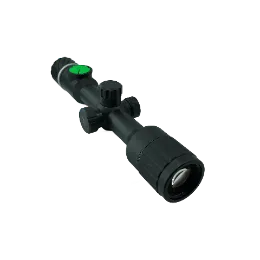
The lens has the biggest effect on range. A longer focal length puts more pixels on a distant target but narrows the field of view. The JOVSTAR JV-TSRII4 series shows the trade-off clearly, with the same 384×288 detector and three lenses:
| Model | Lens | Field of view | Person detection / recognition |
|---|---|---|---|
| JV-TSRII425 | 25 mm | 14.9° × 11.2° | 1,670 m / 475 m |
| JV-TSRII435 | 35 mm | 10.7° × 8.0° | 1,900 m / 584 m |
| JV-TSRII454 | 54 mm | 6.9° × 5.2° | 2,100 m / 680 m |
A wide lens suits woodland, buildings and close search, where targets appear suddenly. A long lens suits open fields, coastlines and hillsides.
3. Choose the Detector: Resolution and Pixel Pitch
Resolution sets how much detail the image holds and, with the lens, how wide the view is. 384×288 is a cost-effective standard; 640×480 or 640×512 gives a sharper image and a wider view at the same range. Smaller pixels (12 μm instead of 17 μm) give more range from the same lens. Among JOVSTAR monoculars:
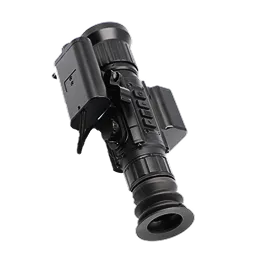
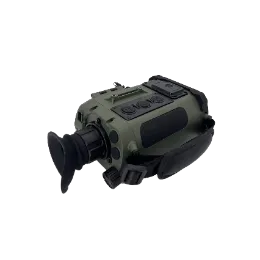
- JV-HTI625: 640×480, 25 mm lens, 28.7° × 21.7° view, shutterless imaging.
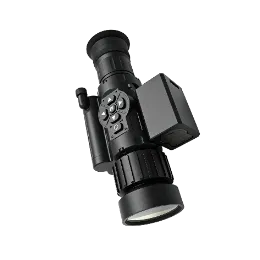
- JV-TSRII4 series: 384×288 with 17 μm pixels, 25, 35 or 54 mm.
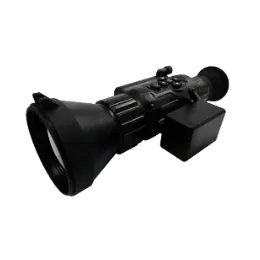
- JV-TSRII350: 384×288 with 17 μm pixels and a 50 mm F1.0 lens.
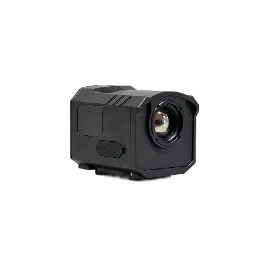
- JV-HTM4125 / 4135: 384×288, 25 or 35 mm.
4. Check Sensitivity (NETD)
NETD is the smallest temperature difference the camera can show. A lower NETD keeps the image detailed when contrast is low: in rain, in fog, at dawn or when a target is partly hidden. JOVSTAR monoculars are rated at ≤40 mK (JV-HTI625), <40 mK (JV-TSRII350) and ≤50 mK (JV-HTM series). For comparison, the multipurpose JV-HTMA213 reaches ≤20 mK.
5. Display, Zoom and Recording
- Display: an OLED microdisplay gives deep blacks and a clear image at night. The JV-HTI625 uses a 1440×1080 OLED; most other models use 1024×768.
- Digital zoom: useful for a closer look, but it enlarges pixels rather than adding detail. JOVSTAR monoculars offer 1–4× continuous or 2×/4×/8×/16× steps.
- Recording and connectivity: the JV-TSRII4 series stores to 16 GB and connects over USB Type-C; the JV-HTI625 adds Wi-Fi, compass and pitch angle.
- Palettes: white-hot, black-hot and color palettes help different users and conditions.
6. Weight, Power and Protection
| Model | Weight | Battery and runtime | Protection | Operating temperature |
|---|---|---|---|---|
| JV-HTI625 | 360 g | 18350 Li-ion, 6–8 h | — | -40℃ ~ +60℃ |
| JV-HTM4125 / 4135 | — | Rechargeable Li-ion, 5 h, USB or power bank | IP66 housing | -20℃ ~ +50℃ |
| JV-TSRII350 | <850 g | 1 × 18650, about 5 h | IP66 | -30℃ ~ +60℃ |
For all-day patrol, carry spare cells or choose a model that runs from a power bank. In cold weather, battery runtime falls, so check the low-temperature limit as well.
Which JOVSTAR Thermal Monocular Fits Your Use
- Light, all-round handheld with Wi-Fi and compass: JV-HTI625.
- Patrol and search with USB charging: JV-HTM4125 (wide) or JV-HTM4135 (longer range).
- Choice of lens with built-in recording: JV-TSRII425, 435 or 454.
- Long-range monocular: JV-TSRII350, person detection at 1,800 m and vehicle detection at 4,500 m.
Need a different lens, detector or housing? Our OEM and ODM service can configure a monocular for your market.
FAQ
What lens should a thermal monocular have?
Use a wide lens such as 25 mm for woodland and close search, and a long lens such as 35–54 mm for open ground. On the JOVSTAR JV-TSRII4 series, human detection rises from 1,670 m with 25 mm to 2,100 m with 54 mm.
Is 384×288 resolution enough?
For most handheld observation, yes. 384×288 is a cost-effective standard; 640×480 or 640×512 gives a sharper image and a wider view at the same range.
How long does a thermal monocular battery last?
JOVSTAR monoculars run about 5 hours (JV-HTM series, JV-TSRII350) to 6–8 hours (JV-HTI625). Battery life falls in cold weather, so carry spare cells or a power bank.
Can a thermal monocular record video?
Some can. The JOVSTAR JV-TSRII4 series records to 16 GB of built-in storage, and the JV-HTI625 adds Wi-Fi.
Need Help Choosing the Right Product?
Tell us your application, target and operating conditions. The JOVSTAR engineering team will recommend a configuration and prepare a quote.
Get a Quote